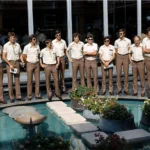
Older generations remember a time when physical education was one of the important subjects in school and was approached with great seriousness. These are the generations that grew up in the first decades after World War II and during the early period of the SFRY.
“Healthy body, healthy mind,” was the slogan, and it is well known that there is no healthy society without the healthy minds of its members, nor is there one without physically healthy people.
The equipment for physical education class was very important – girls wore black leotards, and boys wore shorts and white t-shirts. Footwear consisted of sneakers or ballet flats, which were worn exclusively in the gym.
The class would start with all the students standing in line, waiting for roll call. After roll call, warm-up began, which usually consisted of running two or three laps around the gym.
Gymnastics was a significant part of the lessons and one of the favorite activities. On the mats, students would perform forward and backward rolls, handstands, star jumps, as well as other activities like jumping over pommel horses, walking on balance beams, and skipping rope. Among the sports, handball, volleyball, and basketball were the most practiced.
For most children at the time, this class was one of their favorites. Physical activity and good posture were important, so grades in this subject were highly valued. It’s no surprise, therefore, that this era produced some of the greatest athletes of all time in these regions.
One of the special events from that time, which was connected to physical education class but extended beyond its boundaries, was the celebration of May 25th. Teachers and professors selected skilled, hard-working, excellent, and exemplary students to participate in the parades and the handing over of the relay baton. Taking part in the Youth Day program was a great honor for both the children and their parents.