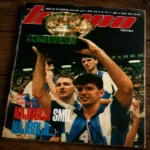
Anyone who remembers May 23, 1970, knows exactly what happened that day. For those who do not, here is the answer: in Ljubljana, Yugoslavia defeated the United States national team and became FIBA World Champion for the first time in its history. It was Yugoslavia’s first-ever gold medal at the FIBA World Championship. That evening, in Tivoli Hall, under the slogan “The Moon is yours, the gold is ours” (“Luna vaša, zlata naša”), the dreams of an entire generation came true.
The team played under enormous pressure. A year before the championship in Ljubljana, Radivoj Korać, the greatest Yugoslav basketball player of that era, was killed in a tragic car accident, almost before the eyes of head coach Ranko Žeravica. Korać had been expected to lead the national team at the World Championship. In his absence, team captain Ivo Daneu was supposed to assume that role, but he was struggling with injuries. To make matters even more demanding, senior Yugoslav politician Stane Dolanc and his political associates had promised President Josip Broz Tito that the team would win the gold medal. Tito himself attended one of the games at Tivoli Hall.
Žeravica built his squad around a combination of experienced veterans and talented young players. The team included seasoned stars Ivo Daneu and Trajko Rajković, alongside the emerging generation born in 1948 and 1949, led by Damir Šolman, Petar Skansi, Ratomir Tvrdić, Željko Jelovac, Dragan Kapičić, Nikola Plećaš, and Krešimir Ćosić, who at the time was studying in the United States. Most of them were only 21 or 22 years old, yet they became the driving force behind the future world champions.
By Žeravica’s decision, there was no place on the roster for celebrated guard Josip “Pino” Đerđa, while another great player, Vladimir Cvetković, was left out after Daneu issued an ultimatum: “Either he goes, or I do.”
The 1970 FIBA World Championship in Ljubljana was the first to be held in Europe. Since the inaugural tournament in Buenos Aires in 1950, every previous World Championship had taken place in South America. The competition featured twelve teams divided into three preliminary groups, while host nation Yugoslavia automatically qualified for the final round. The top two teams from each preliminary group joined the hosts in the championship group.
In the opening game of the final round, Yugoslavia faced a difficult challenge against Italy, a match watched nervously by President Tito from the stands at Tivoli Hall. A few days later, Yugoslavia convincingly defeated Brazil, one of the world’s strongest teams, by 80–55, a victory that paved the way toward the gold medal.
The decisive game came in the sixth round on May 23, when Yugoslavia faced the United States. A victory would secure the world title.
The game tipped off at 8:30 p.m. before a crowd of 8,000 spectators. The American team consisted of the country’s best collegiate players, reinforced by several Americans who were playing professionally for Maccabi in Israel. Yugoslavia opened with Nikola Plećaš, Ratomir Tvrdić, Damir Šolman, Petar Skansi, and Krešimir Ćosić, but foul trouble for several starters gave significant opportunities to Simonović and Dragan Kapičić, who made the most of their minutes.
Yugoslavia built a narrow lead during the first half and extended its advantage to seven points in the 25th minute. Veteran captain Ivo Daneu took control when it mattered most, scoring four crucial points and delivering key assists to Kapičić and Plećaš. The final score was 70–63, and the celebrations could begin. Yugoslavia, long known as the “eternal runner-up,” had finally won its first world championship. Celebrations erupted in cities across the former Yugoslavia.
Nikola Plećaš, who scored the final basket in the championship game, shaved off his trademark mustache for the first and only time after winning the gold medal. He had grown it during preparations for the tournament and has worn it ever since.
The final day of the championship featured a game against the Soviet Union, which had no bearing on the final standings. Following a night of celebrations, Yugoslavia lost 87–72. The day after the tournament concluded and the medals were awarded, the players traveled to meet President Tito, presenting him with the gold medal as a birthday gift on May 25.